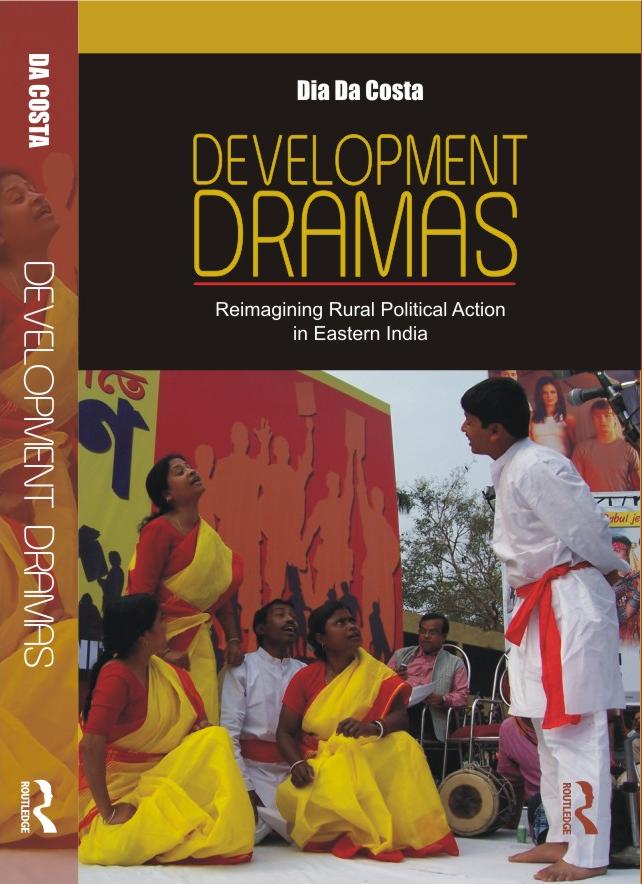
 | Development Dramas: This book is an ethnographic analysis of political theatre and activism by agricultural labourers in India. Instead of viewing political theatre as a means of protest under conditions of repression, this book theorises political theatre as a space of political economy, constitutive of development and social change. The disarming qualities of Jana Sanskriti's theatre normalizes social relations and conduits of political opportunity outside of divisive and violent relations constructed through political parties. Drawing upon and going beyond persuasive conceptions of the West Bengal state as 'party-society,' the book reveals development and culture as complex, ongoing outcomes of rootedness within, alienation from, and struggles against multiple histories of power - from capitalism to state formation, rural cultural practices, and sources of faith and ethical action. |
"Passionate and pioneering, Dia Da Costa's Development Dramas unites intimate and reflexive ethnography with astutely wielded theory and incisive analysis to illuminate "representational struggle" in the lives of very real people in eastern India. At the heart of this work are the plays, politics and convictions of Jana Sanskriti, a small political theater troupe, founded in the nineteen-eighties and still going strong. Da Costa effectively shows how art meshes with politics as the Jana Sanskriti players offer trenchant critiques of corruption, oppression and "minimal regard" for rural lives and livelihoods at local, national and global levels. Da Costa's persuasive counterargument for the intrinsic worth of these lives is invaluable. The compelling and articulate voices transmitted here, not just of the engaged actors but of their reflective audiences, are at times so acute and emotionally wrenching that detached academics will read this book at their peril."
--- Ann Grodzins Gold, Professor of Religion and Anthropology, Syracuse University
"Development Dramas provides an unusual window into everyday politics in rural West Bengal through the experience of a theatre group and the on- and off-stage lives of its actor-participants. Dia Da Costa demonstrates, with great sophistication, how the group's experiments with the 'theatre of the
oppressed' can be seen to illuminate the 'dark side of political society' -a task not yet undertaken seriously. An important contribution to the literature on contemporary West Bengal."
--- Aditya Nigam, Fellow in Political Science, Centre for Study of Developing Societies
OTHER PUBLICATIONS
Refereed Journal Articles
Da Costa, D. (2010). “Relocating Culture in Development and Development in Culture,” Introduction to Special Issue of Third World Quarterly, 31(4).
Da Costa, D. (2010). "Subjects of Struggle: Theatre as Space of Political Economy" Third World Quarterly, 31(4).
Da Costa, D. (2008) “‘Spoiled Sons’ and ‘Sincere Daughters’: Schooling, Security, and Empowerment in rural West Bengal, India” in Signs: Journal of Women and Culture 33(2): 283-308.
Da Costa, D, (2008) “Tensions of Neo-liberal Development: State Discourse and Dramatic Oppositions in West Bengal” in Contributions to Indian Sociology 41 (3): 287-320.
Da Costa, D. and Philip McMichael, (2007) “The Poverty of the Global Order” Globalizations 4(4): 588-602.
Caron, Cynthia M. and Dia Da Costa, (2007) “There’s a Devil on Wayamba Beach: Social Dramas of Development and Citizenship in Northwest Sri Lanka” Journal of Asian and African Studies 42(5): 415-445.
Mohan, D. (2004a), “Re-imagining Community: Scripting Power and Changing the Subject through Jana Sanskriti’s Political Theatre in Rural North India” Journal of Contemporary Ethnography. 33(2): 178-217.
Mohan, D. (2004b), “Jana Sanskriti's Theatre and Political Practice in Rural Bengal: The Making of Popular Culture” South Asian Popular Culture. 4(1): 39-53.
Book Chapters
Da Costa, D. (In press) “Liberating Development from the Rule of an Episteme” in Beyond Development and Globalization: Social Movement & Critical Perspectives Reader Dominique Caouette/UMontreal & Dip Kapoor/Univ of Alberta (Eds.)
Da Costa, D. (2010) “‘Contesting Liquor Production and Material Distress in Rural India" in Philip McMichael (ed.) Contesting Development: Critical Struggles for Justice and Social Change London and New York: Routledge.
Da Costa, D. (2009) "Introduction" in Sanjoy Ganguly, Where We Stand: Five Plays from the Repertoire of Jana Sanskriti, Kolkata: Camp, pp. 9-20.
Da Costa, D. (2007) "Mirrors of Value?: Advertising and Political Theatre in the Hegemonic Constructions of Women in India” in Theatre in the Streets Sudhanva Deshpande (ed.) Jana Natya Manch: New Delhi.
Translation
From Bengali to English: Ganguly, Sanjoy, (2009). Where We Stand: Five Plays from the Repertoire of Jana Sanskriti, Translated by Dia Da Costa, Kolkata: Camp.
Book Reviews
Mohan, D. (2006) Book Review of Ravina Aggarwal’s Beyond Lines of Control: Politics and Performance on the Disputed Borders of Ladakh Durham: Duke University Press. Modern Drama 49(2): 245-8.
Mohan, D. (2003) Book Review of In the Time of Trees and Sorrows: Nature, Power, and Memory in Rajasthan by Ann Grodzins Gold.Seminar. #530: October. 67-70.
